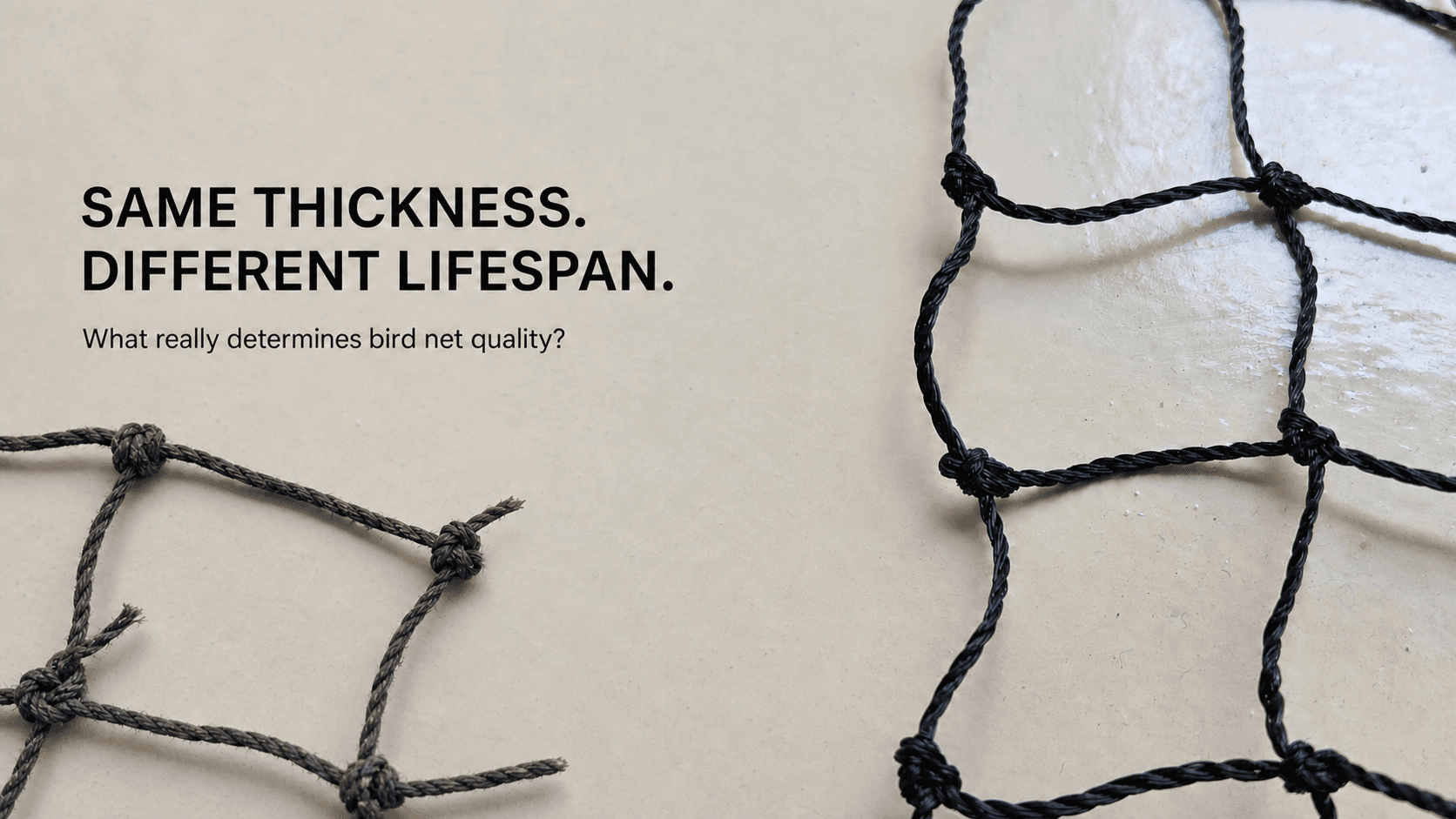
Two bird nets may both be described as 1 mm thick. Same mesh size, same colour, same appearance. Yet one begins crumbling within a few months while the other keeps working for five years or longer.
Quick answer: Thickness only describes the approximate diameter of the net thread. It says nothing about what is inside that thread. The actual lifespan of a bird net is decided by the raw material (virgin vs recycled HDPE), UV stabilization, ply count, twisting and knot quality, and how well the net is installed. Two nets with identical thickness can differ by several years in real working life. We have seen nets fail in 2–3 months and one of our installations last around 8 years.

Two nets of similar thickness can age very differently because material quality and UV stabilization are not visible when new.
If you only remember one thing from this article, remember this: thickness is a measurement, not a quality grade.
Thickness Is a Measurement, Not a Quality Grade
Customers commonly compare one 1 mm bird net with another 1 mm bird net and assume similar strength and durability.
In reality, thickness does not tell you whether virgin HDPE has been used, whether the material is properly UV stabilized, how many strands form the thread, how tightly they are twisted, or whether the manufacturer backs the product with a warranty.
When both nets are new, the difference is usually invisible. Both feel flexible, clean and strong. The true quality only becomes apparent after prolonged exposure to sunlight, and by then, the purchase decision has already been made.
Virgin HDPE vs Recycled Material: The Biggest Hidden Difference
High-quality bird nets are manufactured from virgin HDPE. Virgin material provides better consistency, flexibility and outdoor durability when it is properly UV stabilized.
Lower-priced nets often use recycled, mixed or lower-grade material. Such a net can still be manufactured at the same nominal thickness, but the thread inside behaves completely differently over time.
Deterioration in a poor-quality bird net follows a recognizable sequence:
- The thread begins to harden.
- Its surface becomes rough.
- It loses flexibility.
- Small portions begin crumbling.
- The thread breaks, sometimes suddenly.
Unfortunately, you cannot identify virgin versus recycled HDPE by looking at a finished net. Colour, shine and initial flexibility prove nothing.
The dependable approach is to buy from an established manufacturer and check the complete written specifications. For example, examine the stated material, UV treatment, construction and warranty of a documented product such as the ProNet 35 MM HDPE balcony bird net instead of judging the net visually.
UV Stabilization Matters More Than Thickness
Sunlight is the single greatest cause of outdoor bird-net deterioration.
Ultraviolet radiation gradually damages unprotected polyethylene, making it harder, less flexible and prone to cracking and sudden breakage. Research into polyethylene degradation, including this scientific summary published by NIST, documents how UV exposure causes embrittlement and surface cracking in HDPE.
The practical consequence is important: a thick net without proper UV stabilization can fail earlier than a thinner net made from quality raw material with an effective UV-stabilizing formulation.
There is no household method to confirm how much UV stabilizer is actually present in a net. That requires controlled weathering tests.
The practical safeguards for an ordinary customer are simple:
- Buy from a reputed brand.
- Confirm that virgin material is specified in writing.
- Check that UV stabilization is explicitly mentioned.
- Examine the warranty and its conditions.
The current ProNet specifications state virgin HDPE, UV stabilization and a three-year warranty. These details tell you far more than a listing that merely says “strong” or “heavy-duty.” Also read the applicable ProNet warranty terms to understand exactly what is covered.
Why Black HDPE Nets Usually Resist Sunlight Better
Black HDPE commonly receives additional UV protection from carbon-black pigment. Carbon black absorbs UV radiation and protects polyethylene against photodegradation.
Research on carbon black and polyethylene UV stability shows that it can significantly improve UV durability, depending on its concentration, particle properties and how evenly it is dispersed.
However, colour alone cannot compensate for weak material. A black net can still be made from poor raw material with an inadequate stabilizing formulation.
A properly manufactured black bird net combines:
- Quality HDPE
- Well-dispersed carbon-black pigment
- Additional UV-stabilizing additives
- Consistent thread construction
Black helps, but only on top of good material, not instead of it.
Does Ply Count Matter? 12-Ply vs 15-Ply
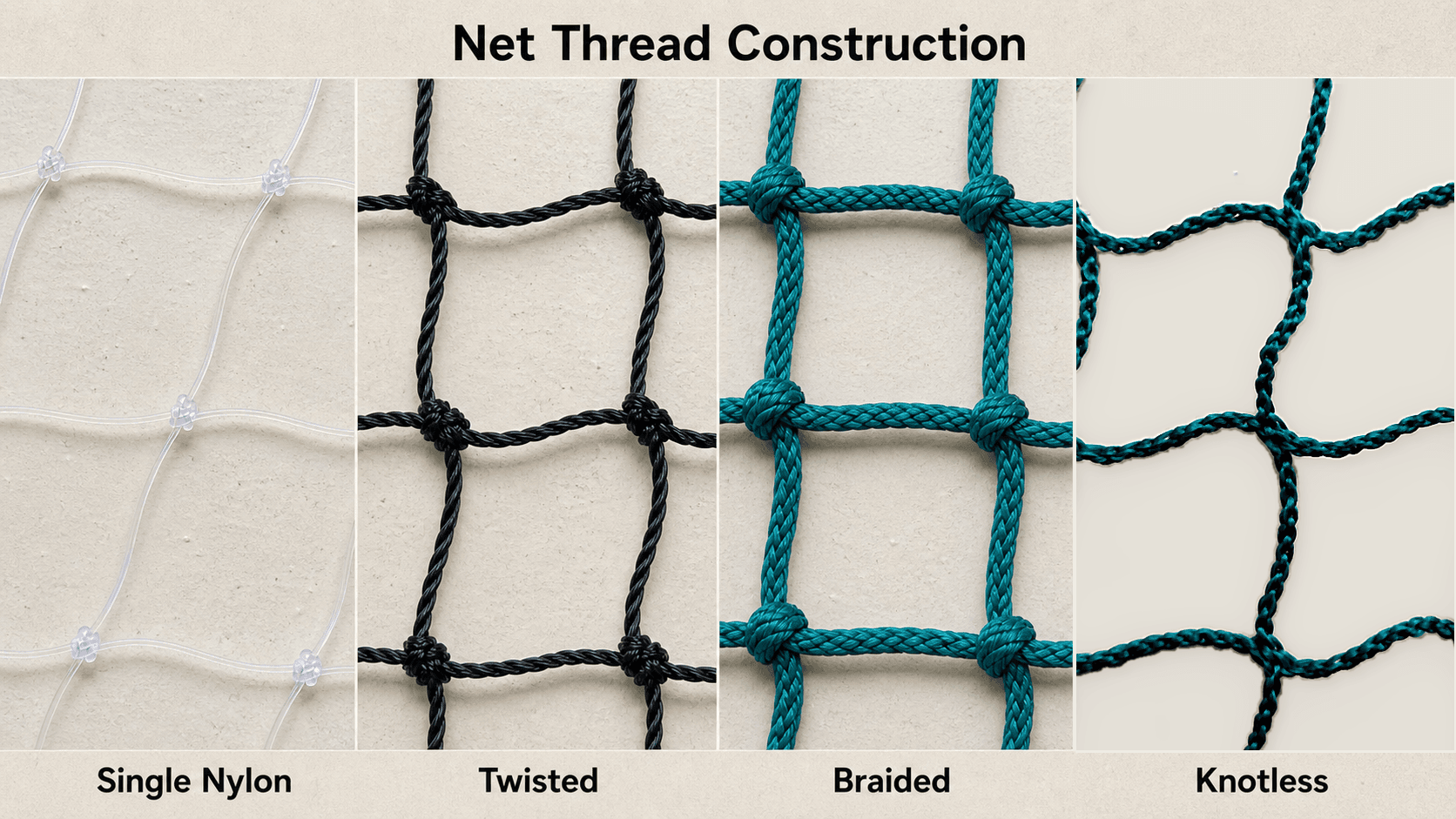
Ply count is the number of smaller strands twisted together to form the thread. A 15-ply thread contains more individual strands than a 12-ply thread.
This does not make every 15-ply net automatically better. A well-manufactured and properly UV-stabilized 12-ply net can outperform a poorly made 15-ply product.
However, when the raw material and manufacturing quality are comparable, 15-ply construction provides redundancy. If one small strand is damaged, the remaining strands continue supporting the thread.
Even two 15-ply nets can differ in lifespan because of differences in:
- Strand uniformity
- UV-stabilizer formulation
- Twisting quality
- Knot consistency
- Raw-material quality
Treat ply count as one factor alongside material and UV stabilization, not as an isolated guarantee.
Twisting, Knots and Mesh Size
A tighter and more uniform twist creates a more stable thread. Loose or inconsistent twisting creates weak sections that deteriorate faster than the rest of the net.
Poorly formed knots can also weaken an otherwise acceptable net or allow the mesh to lose its shape.
In our field experience, however, the thread itself is normally the first component to fail when severe UV degradation has set in. It turns hard and brittle before crumbling or breaking.
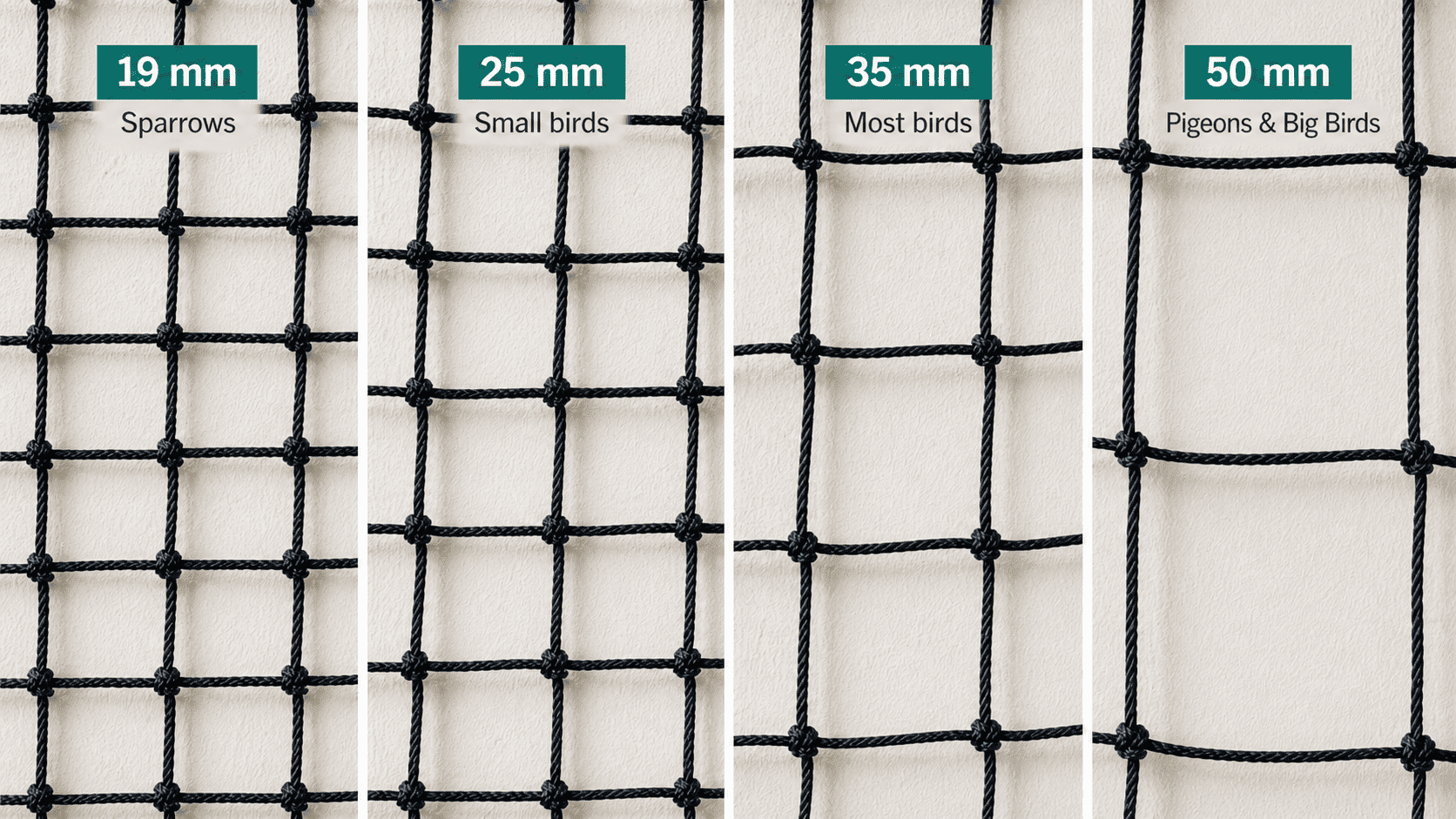
What about mesh size? A 25 mm and a 35 mm bird net can have the same lifespan when both use the same material, thread construction and UV stabilization.
Mesh size determines which birds can pass through, not how long the thread survives. Select the mesh according to the target bird. You can compare different balcony bird nets and pigeon nets by material and application.
How Long Does a Bird Net Actually Last?
The difference between two apparently similar nets can be substantial.
We have encountered poor-quality bird nets that deteriorated within approximately two to three months because both the raw material and UV stabilization were inadequate.
At the other end, one bird net installed by us remained in service for approximately eight years.
The eight-year example is a real installation observation, not a guaranteed lifespan. Actual service life varies with material formulation, sunlight exposure, installation quality and local conditions.
But the lesson stands: two nets sold at the same thickness can differ by several years in actual working life.
Comparison | Virgin HDPE with proper UV stabilization | Recycled or poorly stabilized material |
|---|---|---|
Observed/expected outdoor life | 5+ years; we have observed approximately 8 years | A few months to approximately 2 years |
Failure pattern | Gradual, visible wear over years | Hardening, crumbling and breakage |
Feels different when new? | Usually not | Usually not |
Warranty | Check the written coverage; ProNet provides 3 years | Check whether clear written coverage is provided |
Potential cost over five years | One purchase and installation | Multiple purchases, installations and cleanups |
Installation Can Shorten the Life of a Good Net
Even a premium net can deteriorate prematurely if installed badly. The objective is not maximum tightness. It is clean, consistent tension across the complete installation.
A net that is too loose:
- Looks untidy
- Moves excessively in the wind
- Develops openings near the edges
- Rubs repeatedly against surrounding surfaces
A net that is overstretched:
- Keeps continuous stress on the threads
- Overloads knots and corners
- Shortens its own working life
The net should be firm and evenly tensioned while retaining a small amount of flexibility.
Why Edges and Corners Need Attention
Many bird-net failures begin near an edge because the perimeter carries the net’s tension and transfers it to the fixing points.
If the edges are weak or uneven, normal wind movement repeatedly pulls on a small number of threads.
At Netskart, a 3 mm border rope is provided around the net, with fixing points generally positioned approximately one foot apart depending on the structure. The border rope distributes tension along the perimeter, supports the edges and reduces direct strain on individual mesh threads.
The installation should also prevent the thread from continuously rubbing against walls, railings, pipes or sharp surfaces. Regular friction gradually damages even a strong, UV-stabilized net.
Do You Need Professional Installation?
Professional installation helps on complicated or high-rise balconies, but it is not the only path to a durable result.
A careful DIY installation can work well when:
- The area is measured accurately.
- Suitable fixing accessories are used.
- The border is supported correctly.
- The net is evenly tensioned.
- Every edge is properly closed.
Neat work matters more than the label. Poor professional work can reduce the life of a good net, while a careful DIY installation can perform well for years.

Even tension, supported edges and correctly spaced fixing points help prevent premature failure.
Which Weather Condition Damages Bird Nets the Most?
Sunlight, by a wide margin.
Rain alone does not damage a properly manufactured HDPE net because quality products are water-resistant. Pigeon droppings do not chemically disintegrate the thread.
Dust does not significantly reduce lifespan, although regular cleaning with plain water keeps the net and balcony looking clean.
Avoid harsh solvents, abrasive chemicals and aggressive scrubbing.
Does Balcony Direction Matter?
It would be misleading to assign a fixed lifespan according to balcony direction.
Actual UV exposure depends on:
- Nearby buildings
- Balcony depth
- Shade
- Seasonal sunlight
- Installation position
A west-facing balcony does not automatically mean earlier failure, and a high-rise balcony does not automatically reduce material lifespan.
Wind can expose weaknesses in a loose installation, but height alone does not determine thread durability.
When Should a Bird Net Be Replaced?
A properly installed bird net does not need constant inspection. Checking it approximately once a year is generally sufficient unless visible damage appears earlier.
The first important warning sign is usually a loss of flexibility.
Other warning signs include:
- The thread feels unusually hard.
- Its surface becomes rough.
- Small strands begin separating.
- The net starts crumbling.
- Multiple threads break.
- Damage repeatedly develops around the perimeter.
A small, localized damaged section can sometimes be repaired. Consider complete replacement when deterioration has spread across the net.
Do not trust a severely degraded net merely because most of its surface still appears intact. Once the material has become hard and brittle, additional sections can fail without much warning.
The Real Cost of Choosing Only by Price
Because two products can look almost identical, the cheaper one appears to offer better value.
But replacing a low-quality net repeatedly can cost more than buying a properly specified product once. You may have to pay again for:
- New material
- Installation
- Removal of the deteriorated net
- Cleaning after renewed bird entry
- Delivery
- Your own time
The cheapest bird net per square foot is not necessarily the lowest-cost net over its complete working life.
Checklist: What to Ask Before Buying a Bird Net
Before placing an order, get written answers to these questions. A proper product listing should already cover them:
- What material is used, and is it virgin HDPE?
- Is the net UV stabilized?
- What is the thread thickness?
- How many plies form the thread?
- What is the mesh size, and does it suit the target bird?
- Does the net have a border rope?
- What warranty is provided?
- Which manufacturer produced it?
If a seller can only provide the thickness and price, you still do not have enough information to estimate quality or lifespan.
A listing that only says “strong 1 mm pigeon net” tells you almost nothing.
Compare the published details of a ProNet HDPE balcony bird net with a Garware 25 MM HDPE bird net to see the type of information that should be available before purchasing.
If you are unsure about material or mesh size, this guide to choosing a pigeon net can help.
The Bottom Line
Two bird nets with the same thickness can have completely different lifespans because thickness does not reveal material quality.
Virgin HDPE, UV stabilization, carbon-black formulation, ply construction, twisting, knot quality and installation collectively determine how the net performs outdoors.
Before purchasing, do not ask only:
“How thick is this bird net?”
Also ask:
“What material is it made from, how many plies does it contain, is it UV stabilized, who manufactured it, and what warranty supports these claims?”