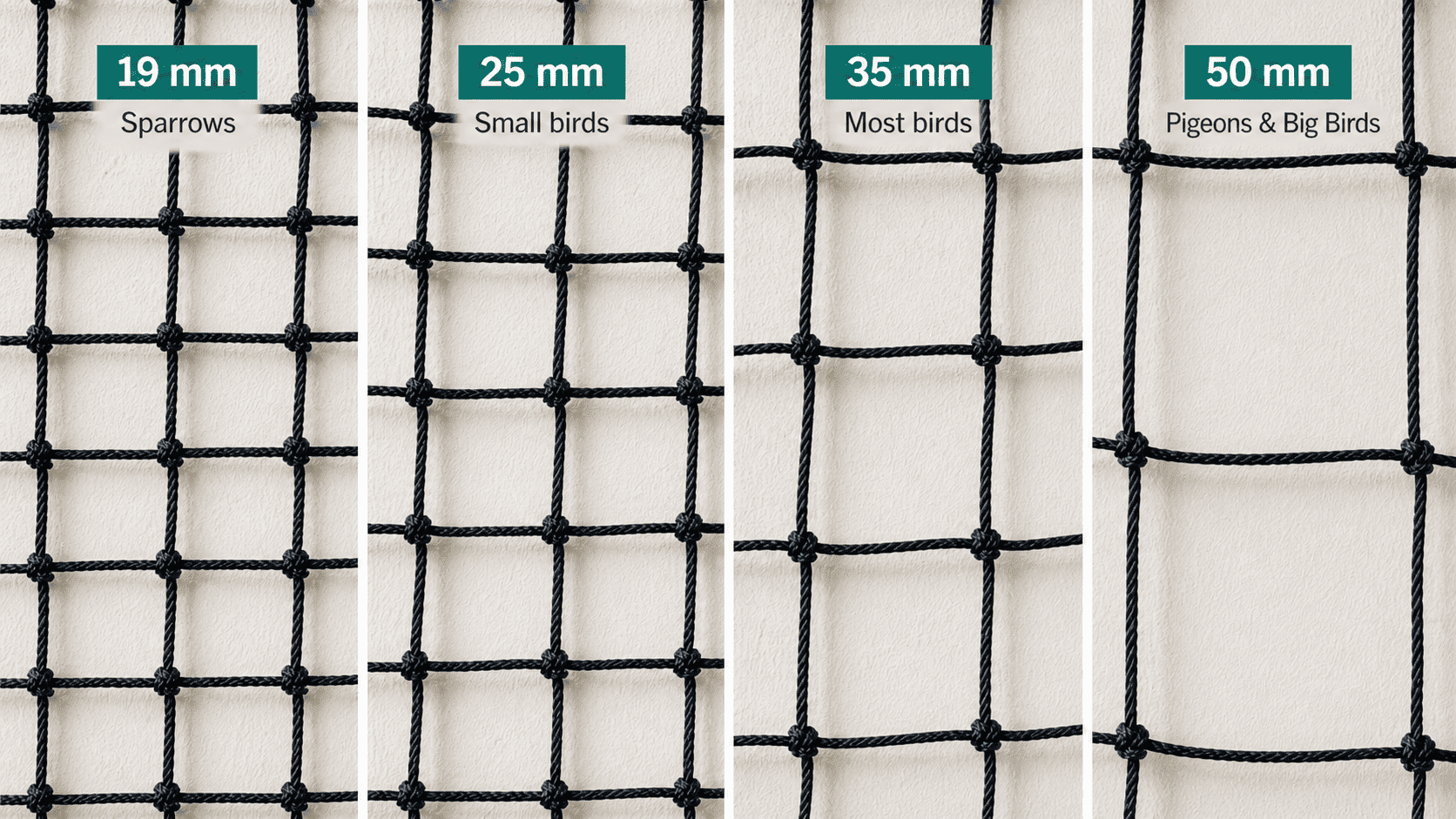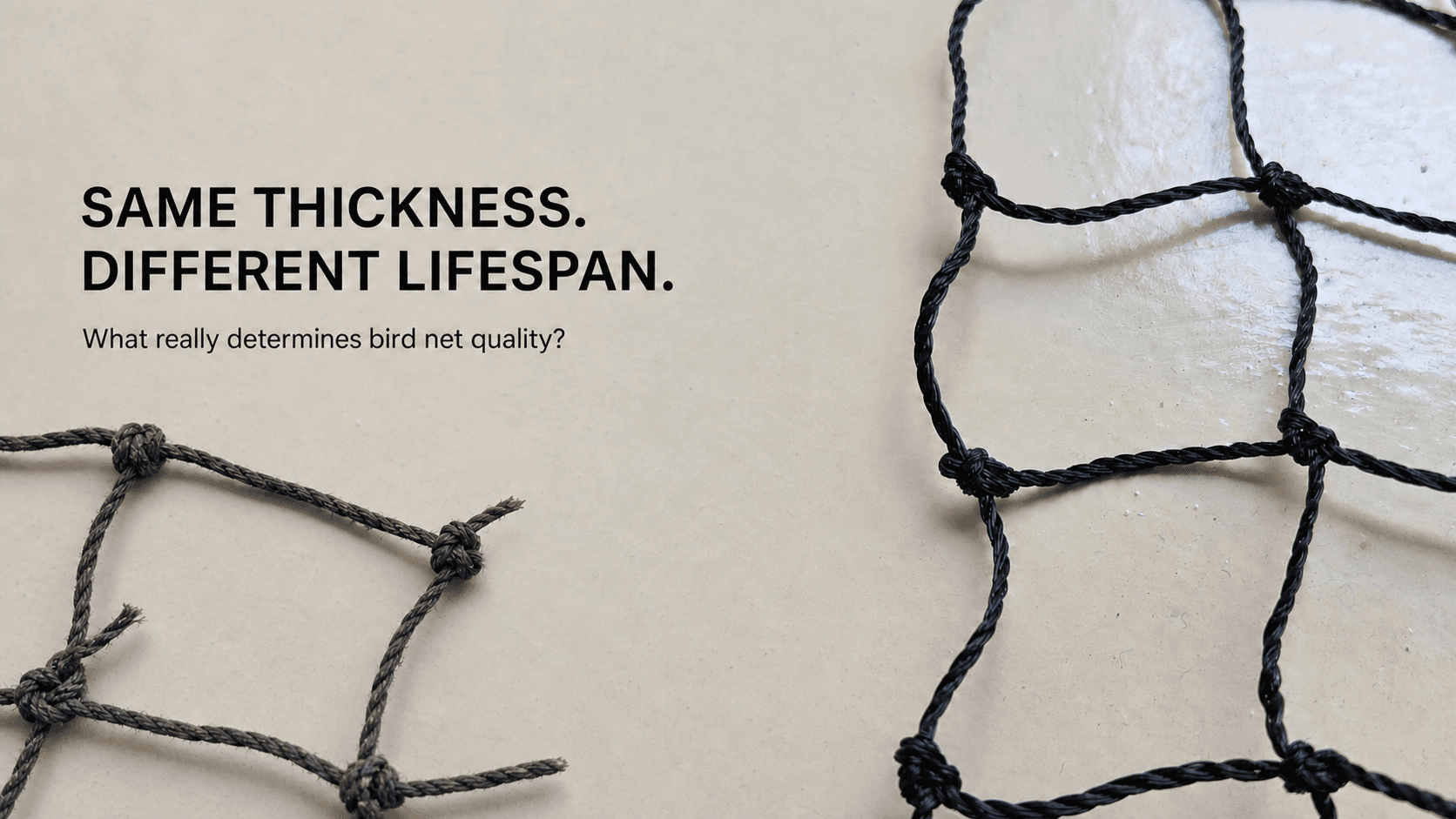
Most people compare three things before buying a net: thickness, mesh size and price. But the real strength and life of a net is not decided by thickness alone.
Two nets can both be 2 mm and still perform completely differently because the material, yarn construction, ply count, UV treatment and raw material quality are different. That is why two nets can look almost identical on day one, yet after a summer or two outdoors, one becomes weak while the other keeps holding.
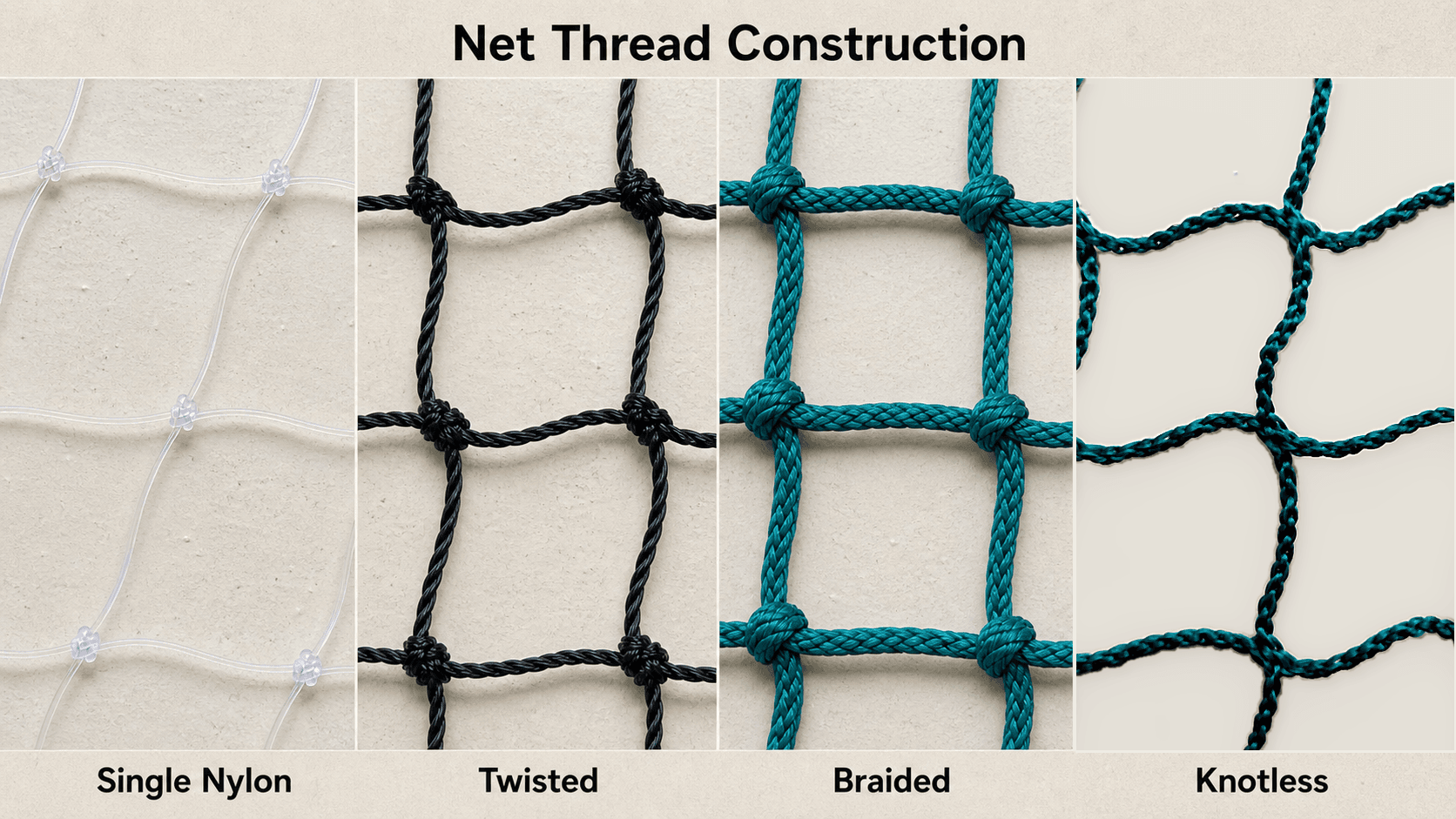
To understand this properly, we need to look at how the thread itself is built. Some nets are made from single nylon wire, some are twisted, some are braided, some are knotless, and some HDPE nets are made in different ply counts such as 12 ply or 15 ply.
This is where the real difference starts.
Why Construction Matters More Than Thickness
“How many mm is the net?” is a fair question, but it is not the only question.
A net should be judged by its material, thread construction, ply count, UV stabilization, raw material quality, mesh size, thickness, use case, border rope and installation method.
A bird net, cricket net and child safety net can look similar from a distance, but they are built for very different loads and risks. A bird net is made for pigeon protection. A cricket net is made to take repeated ball impact. A child and pet safety net is a safety product first, so it should never be selected like an ordinary bird net.
In the formal netting trade, strength is often specified through technical terms like denier and GSM, which means grams per square metre. Ply is the term commonly used in the Indian market. It means the number of strands in the yarn. Ply is useful for understanding quality, but if someone wants to compare two nets more precisely, GSM and material grade should also be checked.
Single Nylon Net
Single nylon net is made from a single transparent nylon wire. It has a clean and almost invisible look, which is why many customers prefer it for balcony bird protection.
In India, nylon bird net is usually costlier because nylon net-making machinery is not widely available locally. Most of the material is imported. This may change in the future if manufacturing starts in India at scale.
Single nylon net is mainly available in transparent form. Unlike HDPE bird net, it is not normally available in black.
You can see examples here:
ProNet Nylon Anti Bird Net 25 MM
https://netskart.com/product/pronet-nylon-pigeon-net-25mm
ProNet Nylon Anti Bird Net 32 MM
https://netskart.com/product/pronet-nylon-bird-net-32-mm
Single nylon has good strength, but it has one structural limitation. Because it is a single wire, if that wire gets damaged at one point, that section depends on only one strand. In a multi-strand HDPE net, if one strand is damaged, the remaining strands can still support the net.
This is one reason why a premium 15 ply HDPE bird net can be a better option for long-term outdoor durability.
HDPE Bird Net: 12 Ply vs 15 Ply
In HDPE bird nets, ply count matters. Ply means the number of strands used in the yarn.
Many low-cost market nets are 12 ply. A 12 ply net is not automatically bad, but in practice many 12 ply nets are made with cost-cutting in mind. They may use non-virgin material, poor raw material or no proper UV stabilization.
That is where the problem starts.
A weak 12 ply net can have lower breaking strength and can degrade faster in sunlight. In real balcony use, this can reduce the net life from around 5-6 years to only 1-2 years. The customer saves money at the time of purchase but pays more later through early replacement.
A genuinely good-quality 12 ply net can last around 3-4 years, but good 12 ply material is rare in the market because many sellers compete mainly on price.
A 15 ply HDPE net has more strands, better durability and better long-term strength. Netskart uses 15 ply virgin HDPE with UV stabilization in its HDPE bird nets. This is why the expected life is around 5-6 years and why a 3-year warranty can be provided.
Visually, the difference between 12 ply and 15 ply is very small. Most people will not notice it by eye. Technically, though, the difference shows clearly in strength, durability and life.
For everyday pigeon protection, one of the strongest practical options is a 35 mm HDPE bird net such as:
ProNet HDPE Balcony Bird Net 35 MM
https://netskart.com/product/pronet-hdpe-pigeon-net
Why Virgin HDPE and UV Stabilization Matter
Outdoor nets face heat, sunlight, dust, rain and pollution throughout the year. Over time, UV exposure naturally weakens plastic-based materials.
A UV-stabilized net is made to handle sunlight better. A non-UV net is not.
Virgin HDPE also performs better than low-grade recycled material because it has better consistency, strength and life. This is the real reason why two nets can look the same on day one but behave very differently after one or two summers.
A cheap net often fails early not only because it is 12 ply, but because it may also be non-UV and non-virgin. These cost cuts together reduce the life of the product.
Twisted Net
Twisted net is made by twisting multiple strands together. It is common in cricket nets and some safety net applications.
In cricket nets, twisted 1.5 mm is usually the entry-level option. It is suitable for lighter home practice where the ball is not repeatedly hitting the same place with high force. But it is not the best choice for heavy or professional cricket practice.
Like any outdoor net, the thread loses some strength over time due to weather, usage and natural degradation. Good installation and proper border support help the net perform better for longer.
Braided Net
Braided net uses a stronger interlaced yarn construction. Because the strands are braided together, it gives better strength and longer life than twisted net.
That is why braided net is very commonly used in cricket netting.
Typical cricket net options are:
1.5 mm twisted net for light practice
2 mm braided net for regular practice
2.5 mm braided net for professional practice
3 mm knotless net for rigorous professional use
For home cricket practice, 2 mm braided net is usually good for children up to around 16 years. For older players or harder practice, 2.5 mm braided is a better choice. This does not mean 2 mm is bad. It depends on the intensity of use and the expected life.
Schools commonly use 2 mm braided net for the whole cricket practice setup. Academies and box cricket setups often use 2.5 mm on the side walls and 1.5 mm on the top because the top does not usually take ball impact like the sides.
For professional cricket, 2.5 mm braided net is commonly used. For more rigorous professional practice, 3 mm knotless net is used.
Knotless Net
Knotless net is not simply any net without visible knots. It is a specific type of net construction.
In a knotless net, the yarn is built in a way that gives the net a smoother surface and higher durability than a normal knotted net. It looks cleaner and generally gives better long-term strength.
In cricket nets, 3 mm knotless net is the strongest among these options because of its construction and thickness. It is more expensive than twisted and braided nets, but it gives longer life.
One important point is that knotless net does not magically absorb ball impact better. Ball impact absorption depends on net flexibility, installation tension and the overall setup. The real advantage of 3 mm knotless net is durability and longer life.
Child Safety Net vs Cricket Net
Child safety nets and cricket nets can use similar construction types, but the purpose is completely different.
A cricket net is made to stop ball impact. A child safety net is used for balcony fall protection. So the selection has to be more serious. It should never be selected like a bird net.
For child and pet safety, 2.5 mm braided net is generally recommended with 50 mm mesh size. This combination gives a strong and practical balance for balcony safety.
In controlled testing conditions, a 2.5 mm braided child safety net can be rated for around 60 kg load capacity, depending on the product, installation and test setup. Always confirm the rating against the specific product and installation method before treating it as a safety specification.
When it comes to safety, nothing is too expensive if it is genuinely stronger. But in terms of price, 3 mm knotless net is costlier, which is why 2.5 mm braided net becomes the practical choice for most homes.
A relevant example is:
Garware Child & Pet Safety Net 50 MM
https://netskart.com/product/garware-child-safety-net-50-mm
Border Rope Also Matters
The thread matters, but the edge also matters.
For proper installation and extra support, Netskart provides 3 mm border rope with every net regardless of the main net type. This helps the installer tension the net properly and gives stronger edge support.
In many poor installations, the thread is not even the weak point. The border, knots, hooks and fixing points are. A strong net with weak installation is still not a good safety solution.
Bird Net vs Cricket Net vs Child Safety Net
Single nylon bird net is made from single transparent nylon wire and is mainly used for balcony bird protection.
HDPE bird net is made in 12 ply or 15 ply construction and is mainly used for pigeon protection.
Twisted cricket net is usually 1.5 mm and is used for light cricket practice.
Braided cricket net is usually 2 mm or 2.5 mm and is used for regular and professional cricket practice.
Knotless cricket net is usually 3 mm and is used for rigorous professional practice.
Child safety net is usually 2.5 mm braided net and is used for balcony child and pet safety.
Strength Ranking
For bird net durability, assuming proper UV treatment and material quality, the general ranking is:
Low-quality 12 ply HDPE < good-quality 12 ply HDPE < single nylon / 15 ply virgin UV-stabilized HDPE
For cricket and safety net strength, the general ranking is:
Twisted 1.5 mm < braided 2 mm < braided 2.5 mm < knotless 3 mm
But this ranking only works when the material quality and UV treatment are proper. A badly made thicker net can still perform worse than a properly made thinner net.
The Biggest Mistake Customers Make
The biggest mistake customers make is buying only by price.
A cheap net may look attractive at the time of purchase, but if it is non-UV, non-virgin or low-ply, it can fail in 1-2 years. This can make it more expensive than a better net that lasts 5-6 years.
This matters most in balcony bird nets and child safety nets, where replacement cost, installation effort and safety expectations are all important.
Most customers do not know the difference between 12 ply and 15 ply. They simply ask for “bird net.” Because of this, some local vendors may sell lower-grade material without explaining the construction clearly.
Final Recommendation
Do not buy a net only by looking at thickness. First understand the yarn construction, ply count, material, UV stability and use case.
For bird protection, 15 ply virgin UV-stabilized HDPE gives the best long-term durability. For cricket practice, braided and knotless nets are stronger choices depending on the level of play. For child and pet safety, choose strength and safety first, not price.
A good net is not just a mesh. It is a combination of material, construction, UV life, thickness, mesh size and installation quality.