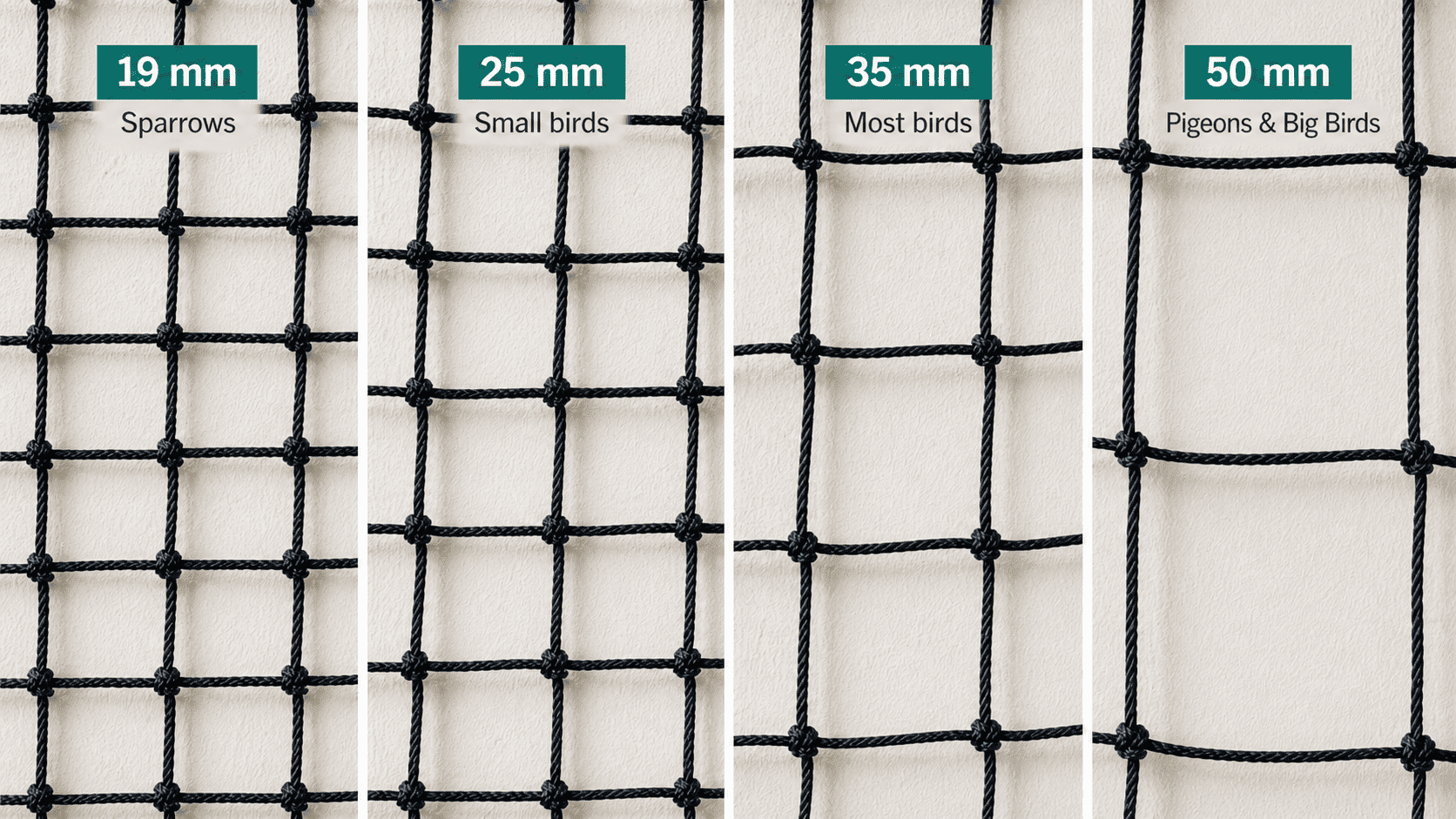
For pigeon protection, 50 mm mesh is technically enough because pigeons and bigger birds cannot pass through it. 35 mm is usually chosen by customers who want extra confidence, while 25 mm and 19 mm are better for smaller birds.
Most customers choose bird net by looking at thickness, but for bird protection, mesh size is just as important.
Thickness tells you how strong the thread is. Mesh size tells you which bird can pass through the opening.
So before choosing a balcony bird net, the first question should be simple:
Which bird are you trying to stop?
Quick Answer
Bird Problem | Recommended Mesh Size | Best Use |
|---|---|---|
Pigeons and bigger birds | 50 mm | Best technical choice with cleaner view |
Pigeons + extra customer satisfaction | 35 mm | Most preferred balcony bird net size |
Medium and smaller birds | 25 mm | When smaller birds are also entering |
Sparrows and very small birds | 19 mm | For very small birds, ducts, shafts and utility gaps |
If your problem is only pigeons, you do not always need the smallest mesh. A wider mesh can protect the balcony properly while keeping the view more open.
What Mesh Size Means in Bird Net
Mesh size means the opening size in the net.
A 50 mm mesh has a bigger opening.
A 35 mm mesh has a smaller opening.
A 25 mm mesh is tighter.
A 19 mm mesh is tighter again and is used for very small birds.
The smaller the mesh, the more net structure appears in the same balcony area. This can slightly affect visibility and cost, but it also helps block smaller birds.
You can see different balcony bird net options on the Netskart bird net category, where mesh size is mentioned according to the use case.
50 mm Mesh: Best for Pigeons and Bigger Birds
For pigeons, doves, crows and bigger birds, 50 mm mesh is technically enough.
A pigeon cannot pass through a proper 50 mm bird net. So if your only problem is pigeons entering the balcony, sitting near the railing, nesting or creating droppings, 50 mm solves the actual problem.
It also gives the cleanest view because there is less net material in front of your eyes. The balcony feels more open, and air and sunlight pass easily through the net.
So the technical recommendation is clear:
For pigeons and bigger birds, 50 mm is the best mesh size.
35 mm Mesh: The Most Preferred Balcony Choice
Even though 50 mm is enough for pigeons, many customers still prefer 35 mm.
The reason is mental satisfaction.
Most people are unsure while buying a bird net. They keep thinking, “Will pigeons really stop with this much gap?” Because of that doubt, they feel more comfortable with a slightly smaller mesh.
This is why 35 mm becomes the most sold option. It still gives good visibility, blocks most birds, and gives the customer extra confidence.
If you want a balanced balcony bird net, ProNet HDPE Balcony Bird Net, 35 MM Mesh is a practical choice.
25 mm Mesh: For Medium and Smaller Birds
25 mm mesh is useful when the issue is not only pigeons.
If medium or smaller birds are entering the balcony, then 35 mm or 50 mm may not be enough. In that situation, 25 mm gives tighter protection.
But for pigeon-only problems, 25 mm is usually more than necessary. It can cost more and look slightly more visible because the net has more thread structure in the same area.
A 25 mm option like Garware HDPE Bird Net, 25 MM Mesh makes more sense when the customer has actually seen smaller birds entering.
19 mm Mesh: For Sparrows and Very Small Birds
Sparrows are very small, so they need a tighter mesh.
For sparrows, small ducts, shaft areas, kitchen-side gaps, utility openings and places where even small birds or small animals should not enter, 19 mm mesh is the better choice.
This mesh is not needed for every balcony. It should be selected only when the problem is clearly small-bird entry.
Does Smaller Mesh Block View, Air or Sunlight?
Smaller mesh is more visible because there are more threads in the same area.
But it does not behave like a curtain. It does not fully block the view, air or sunlight. All bird nets have holes, so the balcony still gets enough light and ventilation.
The difference is mainly visual comfort.
If you want the cleanest view and your problem is pigeons, choose 50 mm.
If you want a tighter-looking net for peace of mind, choose 35 mm.
If smaller birds are entering, choose 25 mm or 19 mm depending on the bird.
Does Mesh Size Affect Strength?
Thread thickness and material quality affect strength more than mesh size.
Still, smaller mesh can slightly increase the combined web strength because there are more intersections and more connected net structure in the same area.
But for bird protection, do not choose mesh size only for strength. Choose it according to the bird problem first.
A good-quality UV-stabilized 50 mm HDPE net can be more useful for pigeons than a poor-quality smaller mesh net.
Common Buying Mistake
The biggest mistake is buying a smaller mesh than necessary.
Many customers choose 25 mm when 35 mm or 50 mm would have solved their problem. It gives mental peace, but it also increases cost and makes the net slightly more visible.
Another issue is wrong product supply. A customer may ask for one mesh size and receive another. For example, someone asks for 25 mm but receives 35 mm, or asks for 40 mm and receives 50 mm.
So always check the product specification before buying.
Ask:
What is the exact mesh size?
Which bird is this mesh size recommended for?
Is the net UV-stabilized?
Is the material suitable for outdoor balcony use?
Final Recommendation
For pigeons and bigger birds, choose 50 mm.
For a balanced balcony bird net with extra mental satisfaction, choose 35 mm.
For medium and smaller birds, choose 25 mm.
For sparrows and very small birds, choose 19 mm.
The right bird net is not always the smallest mesh. The right bird net is the mesh size that matches the bird you actually need to stop.