Most people assume that a white balcony bird net will be less visible because white feels light, clean and open. In real balcony conditions, the opposite is usually true.
For balcony bird nets, black is generally the least visible colour, followed by transparent, and then white. In our experience, nearly 95% of customers initially ask for white net, yet most people prefer black after seeing the actual result, because black does not strike the eyes the way white does.
This is not just a style preference. It is connected to colour theory, light reflection, contrast and how the human eye sees a mesh against an outdoor background.
The Common Customer Assumption: "White Will Be Less Visible"
When customers choose a balcony bird net, many ask for white first. The reason is easy to understand. White is associated with brightness, cleanliness and openness. We use white paint in homes to make rooms feel bigger and brighter, so people naturally assume the same rule will apply to balcony nets.
But a net is not a wall. A bird net is a fine mesh placed between your eyes and the outside view. In this case, visibility depends less on whether the colour is "light" and more on how much light each thread reflects back to your eyes.
That is where black performs better.
Why Black Bird Net Looks Less Visible
Colour theory says black absorbs more light, while white reflects more light. Adobe explains this basic colour principle clearly: white is seen when a surface reflects nearly all light, while black is seen when very little light is reflected back to the eye. You can read the colour theory reference here: Adobe on black, white and light reflection.
In a balcony bird net, this matters because every thread of the net can either reflect light or absorb it.
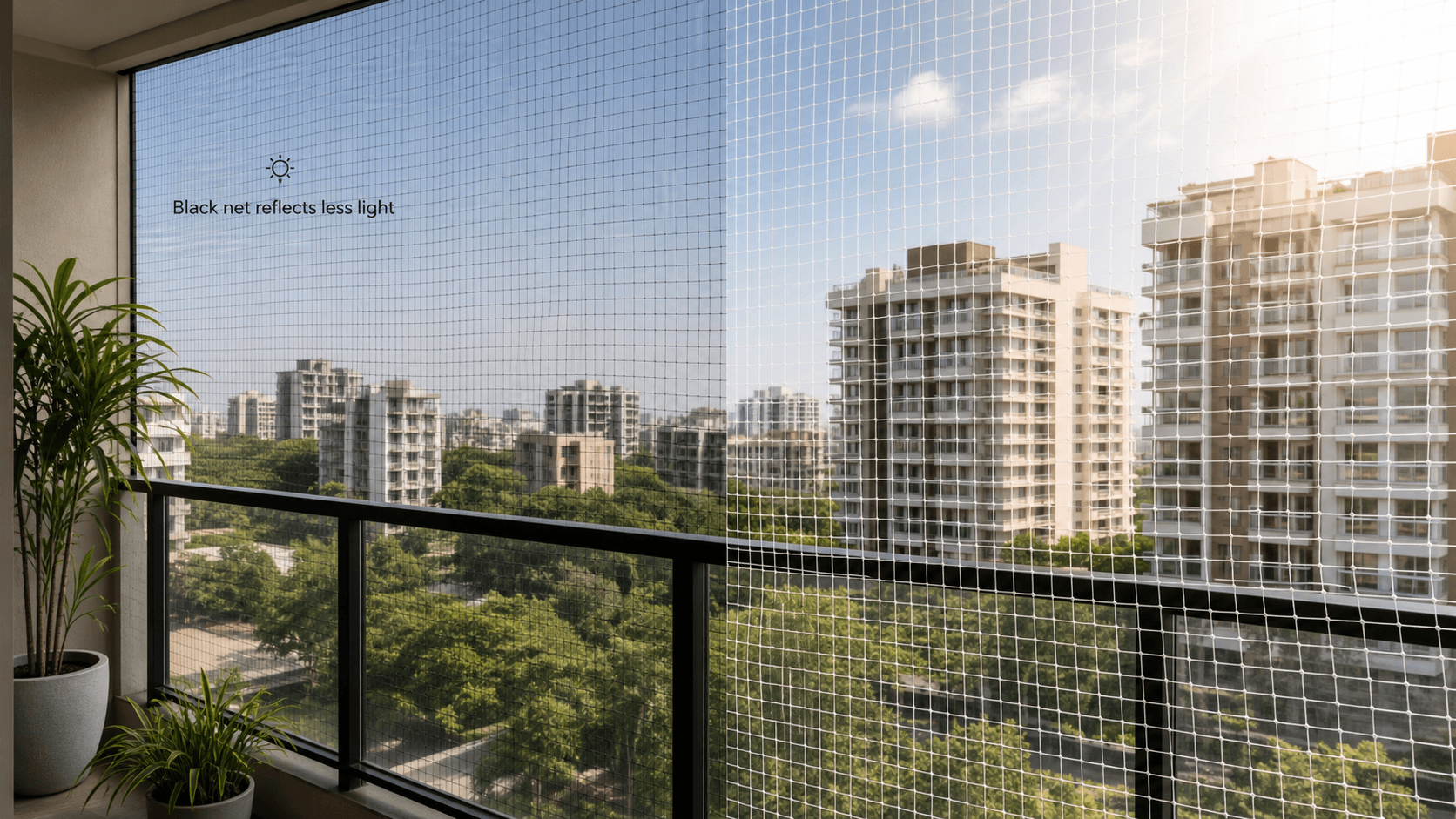
A white net reflects more sunlight, so every thread becomes more noticeable. A black net reflects much less light, so the threads do not catch the eye as strongly. Your eyes are not distracted by the reflected light, and your brain focuses more on the background view behind the net.
This is why black mesh often appears almost invisible from normal viewing distance.

Visibility Is About Contrast, Not Just Colour
The biggest technical point is this:
A net becomes visible when it creates contrast against the background.
Visual perception studies and visibility guides explain that contrast between an object and its background is one of the main reasons we notice that object. A useful reference on this is Visual Expert’s explanation of contrast and visibility.
In Indian apartments, the background behind and around a balcony net is usually not plain black. It is often light-coloured balcony paint, nearby buildings, sky, concrete walls, garden views, grills or glass railings. Against these backgrounds, white and green nets reflect more light and create more visible contrast from a distance.
Black net does the opposite. It absorbs more light and creates less glare, so it blends into the view more easily.
That is why from far away, white and green balcony nets are usually the most visible, while black remains the least visible.
Black vs Transparent vs White Bird Net
In practical balcony use, the visibility ranking is usually:
- Black bird net: least visible
- Transparent bird net: moderately visible
- White bird net: most visible
Transparent net sounds like it should be invisible, but in reality, it still reflects sunlight. A transparent thread can shine, catch glare and become visible from certain angles. It is less visible than white in many cases, but it is usually not less visible than black.
White net reflects more light, which makes it brighter and more noticeable. Black net absorbs more light, so it stays visually quieter.
This same principle applies to other mesh applications too. Darker insect screens and window meshes absorb more light and allow better outside visibility, while lighter-coloured meshes reflect more light and are harder to see through.

Does Black Net Make the Balcony Dark?
Technically, black absorbs more light than white. So if you stare at the net closely, black can feel slightly denser than white.
But in a balcony bird net, the mesh is thin and open. It does not block meaningful airflow, and it does not block daylight the way a curtain, shade or wall would. A standard balcony bird net is mainly a protective barrier against pigeons and birds. It is not a solid surface.
For example, common balcony bird nets such as the ProNet HDPE Balcony Bird Net are designed to keep the balcony protected while allowing air and light to pass through.
So practically, black net does not make the balcony dark in any major way. Instead, it reduces visual distraction because the threads do not reflect as much light into the eyes.
Why White Net Looks Brighter but More Noticeable
White has a reflective property. That is why white walls can make a home feel brighter and bigger. The same effect happens with white net, but in this case, brightness is not always an advantage.
A white balcony net reflects sunlight and becomes visually active. It can create a web-like layer in front of the view. From inside the balcony, the eye notices the white threads. From outside the building, the white grid can also stand out more clearly.
So yes, white net may make the area feel slightly brighter, but it also makes the net itself more visible.
Maintenance: Which Colour Looks Cleaner Over Time?
Good-quality bird nets — whether black, white or transparent — can be cleaned with water if there is dust, pollution, rain marks or pigeon dirt. Net quality matters here. A strong UV-stabilized net will hold its structure and stay maintainable over time.
But visually, white usually needs more care. Small dirt marks, pollution buildup and stains tend to show more easily on white surfaces. This is similar to how a white car can look dirty faster when dust or marks settle on it.
Black net generally hides this visual layer better and looks cleaner for longer in normal balcony conditions. Both black and white nets can maintain their appearance if cared for properly, but white needs more frequent attention to keep looking fresh.
Lifespan and UV Stability
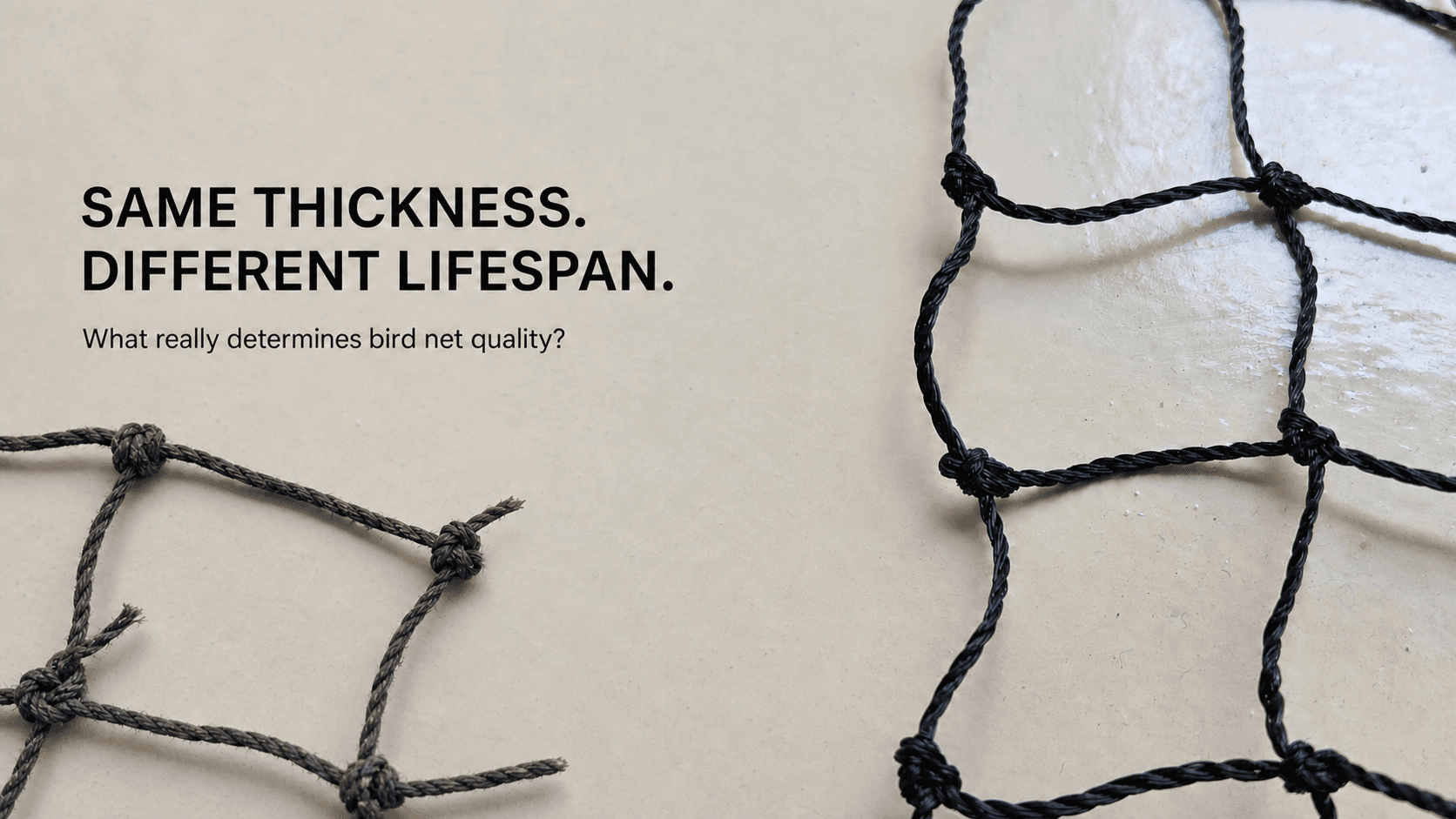
Another practical advantage of black net is its long-term performance. In netting materials, black pigmentation is commonly associated with better UV resistance, because carbon-black pigment can support UV stability. Even when all nets are UV-stabilized, black generally has the longest lifespan among colours due to this natural UV-stabilizing advantage.
This does not mean white or transparent nets are weak if the quality is good. A proper UV-stabilized net can work well. But when colour is considered as a factor, black usually has the strongest long-term advantage.
Don't Confuse the Colour Decision With the Safety Decision
Colour affects visibility, but thickness affects use case — and the two should not be mixed up.
A balcony bird net is usually lighter and thinner because its main purpose is to stop pigeons and birds from entering the balcony. Many bird nets are around 1 mm thickness depending on the product type.
Child and pet safety nets are different. They are built for stronger safety support, so they are generally thicker — often around 2.5 mm thickness, such as the Child & Pet Safety Net for Balcony at Netskart.
So choose based on the job: for bird protection, pick the right bird net and then choose its colour. For child or pet safety, choose a proper safety net first.
When Should Someone Choose White Bird Net?
White net is not technically the least visible choice. But it can still make sense if someone specifically wants to match the home colour theme, white balcony grills, white walls or a particular design preference.
If the priority is colour matching, white can be chosen.
But if the priority is least visibility, a better view and long-term visual cleanliness, black is usually the better choice.
What Installers Usually Do
Installers generally do not have a fixed colour preference. Most installers sell what the customer asks for. Since most customers initially ask for white, white gets installed often.
But that demand is usually based on assumption, not technical understanding.
When customers who previously had white nets replace them with black, they often feel that black was the better choice. The most common reaction is that black does not hit the eyes and the balcony view feels cleaner.
Final Recommendation
For most apartment balconies, a black balcony bird net is the best colour choice if your priority is minimum visibility, a better outside view and long-term appearance.
White net looks bright, but it reflects more light and becomes more noticeable. Transparent net is better than white in many cases, but it can still reflect sunlight and shine. Black absorbs more light, produces less glare and lets the eyes focus on the background view instead of the net. So the least visible bird net is not the lightest colour. The least visible bird net is the colour that reflects the least light and creates the least glare against the background. In most balcony conditions, that colour is black.